Facades

Facade construction from material choice to detail: projects and technical articles, grouped by cladding material.


Glass

  • The fly tower of the Glasshouse Theatre consists of textured prefabricated concrete elements, while the ­existing QPAC displays smooth in-situ concrete. The continuity of colouration, however, is clearly visible.

    Glasshouse Theatre in Brisbane

    The Glasshouse Theatre adds a fifth venue to the heritage-listed Queensland Performing Arts Centre. It can be flexibly used for concerts, operas, and dance and theatre performances. The glass facades of the deeply cantilevered foyer visualise the theatrical art of illusion on the exterior.

  • From Serial Logic to Architectural Expression

    Projects such as the Federal Environment Agency headquarters in Dessau or the temporary residence of the Federal President in Berlin show: For more than two decades Sauerbruch Hutton have been advancing timber construction both in terms of materials and systems. How much repetition can a building tolerate - and where does architecture begin when applying serial production methods? Four modular construction projects offer answers to this question.

  • Housing for the homeless often consists of stacked contain ers. While the overnight shelter designed by Hild und K utilises prefabrication, thoughtful details adorn the robust building through which the Munich-based office conveys impres sions of warmth and home.

  1. Project
  2. Project
  3. Project
  4. Project

Metal

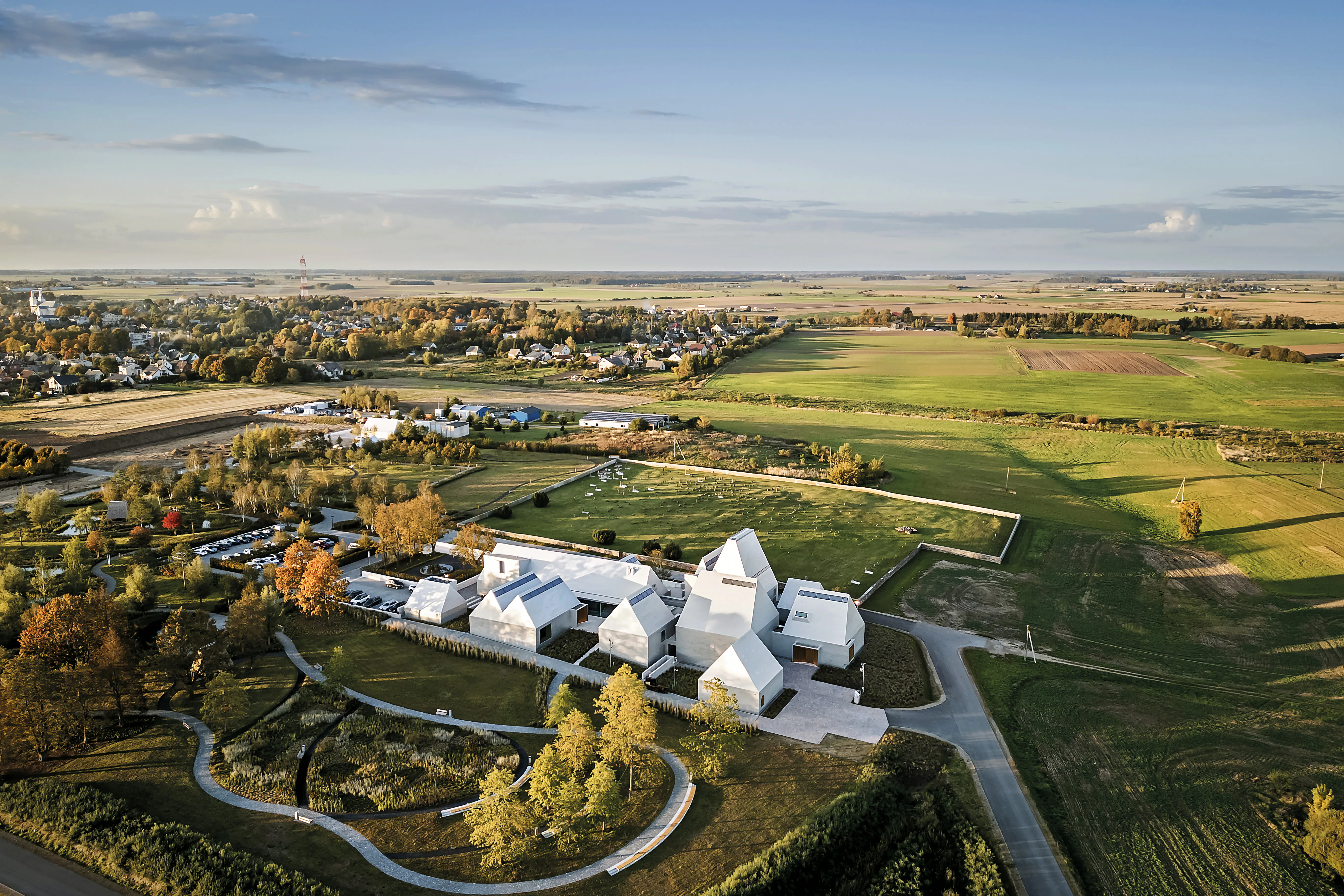
  • The Lost Shtetl Museum in Lithuania

    The Jewish Museum in Šeduva commemorates the culture of Eastern European towns before World War II. With their building, Lahdelma & Mahlamäki Architects from Finland reimagine the small-scale structure of one such village. Its residents were murdered in 1941 by Nazis and their local collaborators.


Wood

  • Good Details Celebrate the Solution

    Dorte Mandrup is known for her idealism and an unmistakable sense of humour. Her ambitious building for the Crafts College in Herning, Denmark, promotes education and craftsmanship. The Copenhagen studio received an award at the 2025 Holcim Foundation Awards. Following the award ceremony in Venice, we spoke about concrete spaces, the freedom of hand-drawn sketches - and why sailing and architecture speak the same language.


Concrete


Masonry

  • Paul Van Ostaijen Culture Campus in Leuven

    Lava architecten transformed an old mission building in Leuven into a place where circus arts, music, theatre, and dance coexist under one shared roof. Effective soundproofing is the precondition for the shared use of the facility.

  • The monastery originally comprised four wings and a cloister. In the south, a squat church with a single nave connects to the complex. The head building with its three apses, a bell tower, and a transept were added in the 13th century.

    Monastery of Santa María of Sijena

    In their restoration of the Monastery of Santa María of Sijena, Pemán y Franco and Sebastián preserve traces of destruction, rebuilding, and decay spanning 800 years. Recently, they remodelled the east and north wings into an exhibition space for the convent’s valuable artworks.


Natural stone


Render

  • The inner courtyards are enclosed with polycarbonate, creating a solar chimney effect. In summer, warm air is drawn upward through the space, enabling natural ventilation.

    Raw Rooms - Social Housing in Ibiza

    Peris + Toral Arquitectes defy categorisation. They push the boundaries of residential design through innovative living concepts and material experimentation.

  • Technology: Rendered Facades, but with What Finish?Coloured, Painted or Coated?

    The encyclopedist Isidor of Seville (560-636) described colour as "captive sunlight", while Sir Isaac Newton attempted to fit the colours of the rainbow into a linear, measurable spectrum (ill. 3), and Johann Wolfgang von Goethe developed a non-scientific colour circle (ill. 2) as part of his theory of colour. According to a definition in modern German standards, "Colour is the facial sensation of part of the field of vision that appears unstructured to the eye, by means of which that part - observed with a single, unmoving eye - can be solely differentiated from a similarly unstructured adjoining area seen at the same time.